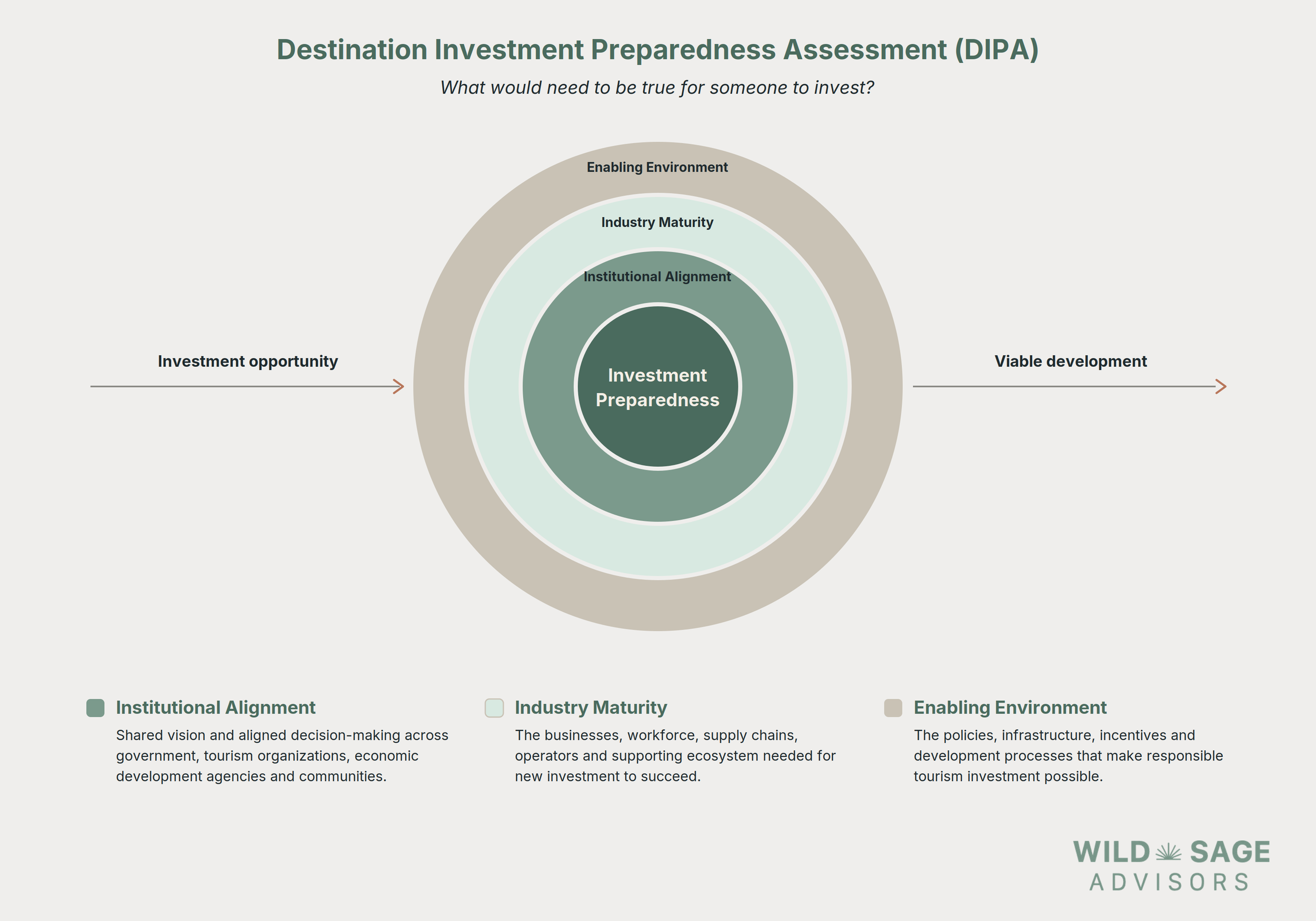
Destination Investment Preparedness Assessment (DIPA)
A structured framework to help destinations understand how prepared they are to attract, facilitate, and sustain responsible tourism investment.
Destinations rarely lack ideas for tourism development. New hotels, attractions, districts, experiences and infrastructure often feature prominently in strategies and master plans. The harder question is whether the conditions actually exist for those ideas to become viable investments.
Rather than asking simply, What should be built?, DIPA asks a more fundamental question: What would need to be true for someone to invest?
From Opportunity to Preparedness
A strong destination brand can attract visitors. Attracting investment requires something different. Investors, lenders, developers and operators are looking for confidence that a destination understands where it is going and has the institutional capacity, industry ecosystem and enabling conditions to support development over time.
DIPA examines those conditions across three dimensions:
Institutional Alignment - Do government, tourism organizations, economic development agencies and communities share a sufficiently clear vision for tourism development, and are responsibilities and decision-making structures aligned to support it?
Industry Maturity - Does the destination have the businesses, workforce, supply chains, operators and supporting ecosystem necessary for new investment to succeed?
Enabling Environment - Are the policies, infrastructure, incentives, development processes and other underlying conditions in place to make responsible tourism investment possible?
Together, these provide a clearer picture not simply of where investment opportunities may exist, but of how prepared the destination is to convert those opportunities into viable development.
Preparing for Investment Before the Investor Arrives
Investment preparedness is rarely about achieving perfect conditions. It is about understanding where a destination stands and deliberately improving the conditions that matter most.
For governments, DIPA can provide a clearer basis for policy and infrastructure decisions. For destination organizations, it can strengthen the case for investment and help define their role in facilitating development. For economic development organizations, it can provide a tourism-specific lens through which to evaluate opportunities. And for prospective investors, greater preparedness can reduce uncertainty and provide confidence that a destination is capable of supporting development beyond the initial transaction.
A Diagnostic, Not a Ranking
DIPA is not intended to produce another destination ranking or investment prospectus. Its purpose is diagnostic.
Through stakeholder engagement, interviews, document review, market analysis and benchmarking, Wild Sage evaluates the conditions shaping investment preparedness and identifies where gaps may be limiting progress.
The result is a practical assessment of what is ready now, what requires further work, and what should come next.
For destinations, this can help prioritize investment opportunities, identify capacity-building needs, strengthen coordination between tourism and economic development, inform conversations with prospective investors, and determine when particular projects, communities or corridors are genuinely ready to move forward.
Attracting tourism investment begins long before an investor arrives. DIPA helps destinations understand whether they have created the conditions that make investment possible in the first place.